


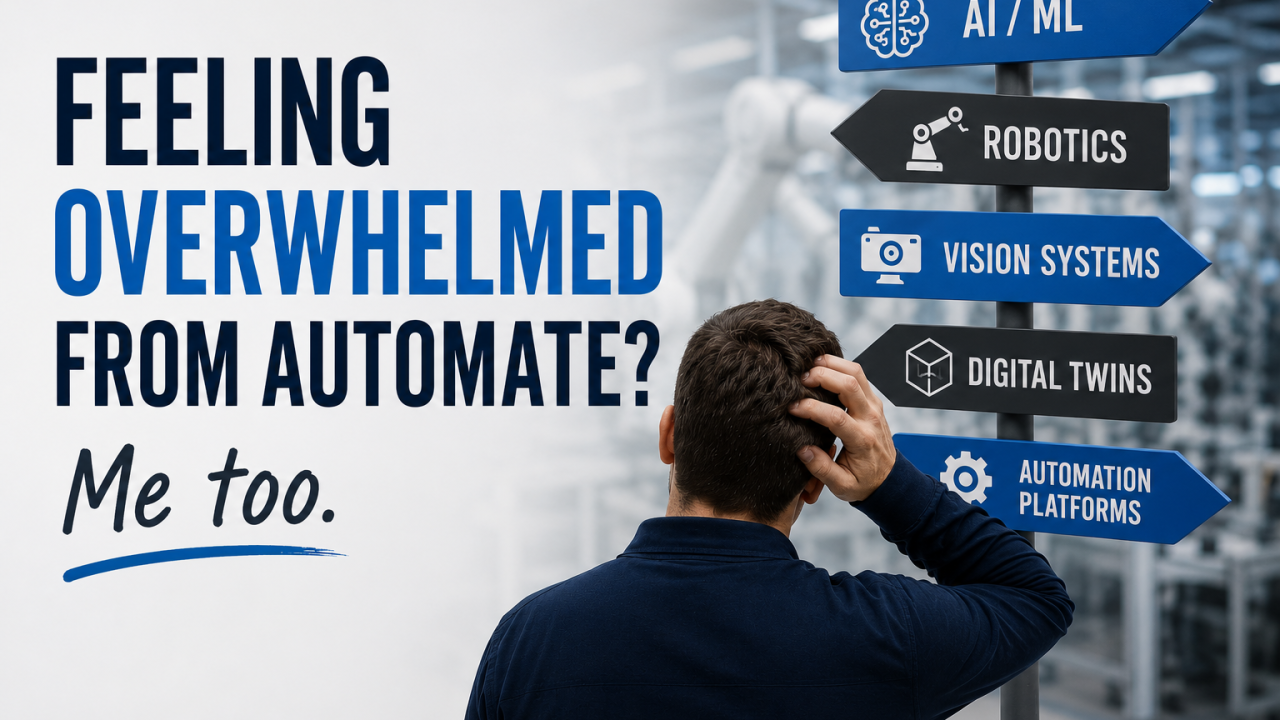
So you went to Automate and left feeling overwhelmed?
You're not alone.
After days of AI demos, robotics, digital twins, vision systems, and automation platforms, it's easy to think the answer is simply buying more technology.
It isn't.
The companies making the biggest gains aren't implementing everything - they're choosing the right problems to solve first.
Here are my biggest takeaways from Automate with respect to the things I saw most: robotics and machine vision.
Robotics
Good Lord there were a ton. The robotics market is clearly getting a ton of seed funding from investors trying to make waves in an already crowded space. The amount of "startup AI" companies that I ran across was the most overwhelming - many of whom I've never even heard of before this week.
(I won't get into the humanoid robotics because I just don't think they're ready to be deployed at scale yet for 99% of manufacturers, but it is something worth keeping an eye on as they make them more capable and affordable. That day will come.)
While these start-up robot manufacturers have nice, interactive demos and a tempting low price, it felt more like a tech show than a showcase of what robotics can do in manufacturing if you are looking for ways to improve your operation in 2026.
My feedback? Stick with the proven providers.
The number of startups I saw at Automate 5 years ago during the "Cobot Boom" that weren't there this week? Many. I see the same happening again.
The barriers to entry are higher than ever and these VCs can only front them for so long. There are reasons that the big players in this space succeed and charge a higher price:
- Local support and service - from distributors, OEMs, integrators, and direct from the manufacturer. Local service and support matters. How fast can you recover when things go wrong? How fast can someone get there to help write a new program or introduce a camera?
- Product breadth - I can standardize my plant on one brand and one programming language.
- Ease of use - product kits, easy programming, ability to easily adapt third-party components like grippers and cameras.
- Quality - you get what you pay for.
Please compare your options. If the manufacturer can't come to your site to perform an onsite demo these days, you have your answer on most of the above.
These new startups need money. They're willing to buy market share right now.
Don't save $10-20K now to spend $60-70K later when the company goes under and you've already dealt with $250K+ worth of headaches and issues. Spend the money to get the result you want.
I'd much rather see my prospective customer buy from a quality competitor and have a good experience than buy a cheap cobot that promises their "AI" will allow you to self-deploy for $20K less. We have already seen this play out. Don't fall for it again.
Machine Vision
I saw no less than 25 machine vision companies promoting their AI capabilities.
The difference here? They probably actually work pretty well.
However, the price you pay for a competitive smart camera these days continues to decrease while the capabilities increase. Going with an unproven startup when using tools to determine part quality seems like the shortcut that isn't worth the risk.
There are newer entrants that are worth looking at - we partnered with Headwall recently, for example, for their experience in the hyperspectral space to solve issues that traditional smart camera manufacturers cannot solve with RGB/monochrome technology. But this isn't a new company — it's a company that has industrialized older tech for the factory automation market. Big difference.
The only way a startup can come into this space, in my opinion, is to win on price alone or to cover a niche part of the market that is not covered by Cognex Corporation already.
The Cognex's of the world already started in the AI/deep-learning space back in 2017 with the acquisition of ViDi, followed by SUALAB in 2019.
What are these new companies going to introduce that hasn't already been done by a company that spends ~$150M annually on R&D?
Conclusion
There were so many options in this space at the show this week that it could easily feel overwhelming.
As a distributor and integrator, we have the option of picking and choosing who we represent and work with in our given territories.
My feedback is to stick with the big names that you know, that have worked out the bugs, and have been investing in the product for a long time. They've been here a long time and will continue to be.
And if you need help, I'm here for support. Reach out to discuss your automation project or submit an RFQ and we'll take it from there.
-Jeff

About the Author
Jeff Fiorini is an automation specialist at Adams Corp, a Florida-based industrial distributor and integrator. He works directly with manufacturers to scope and deploy machine vision, robotics, and machine safety solutions across the Southeast.
Jeff has been on the Automate show floor for years and focuses on helping operations teams cut through vendor noise to find the technology that actually holds up in production.
FAQ
What were the biggest robotics takeaways from Automate 2026?
The volume of AI startup companies on the floor was unlike anything seen before, many offering low-price cobots with self-deployment promises. The core takeaway: stick with proven providers. Established manufacturers offer local support networks, product breadth for plant standardization, easier programming, and track records that startup VCs simply cannot replicate. The pattern of cobot startups flaming out has played out before. Don't let a $10,000-$20,000 discount turn into $60,000-$70,000 in recovery costs down the road.
Are humanoid robots ready for manufacturing deployment in 2026?
Not for most manufacturers. The technology is advancing, but scaled deployment across 99% of production environments isn't there yet. Worth keeping on your radar as a future investment, but not the place to put budget in 2026. Focus on proven collaborative and industrial robot solutions for near-term gains.
Why should manufacturers choose established robot brands over cheaper startup alternatives?
Four reasons that show up every time. First, local support and service: when something goes wrong, how fast can someone get on-site to fix it or write a new program? Second, product breadth: the ability to standardize your plant on one brand and one programming language. Third, ease of use: proven kits, simple programming, and compatibility with third-party components like grippers and cameras. Fourth, quality: you get what you pay for. If a manufacturer can't perform an onsite demo before the sale, that tells you everything you need to know about what support looks like after it.
What is the current state of AI-powered machine vision technology?
AI-powered machine vision is genuinely mature in ways that robotics startups often aren't. Over 25 companies at Automate 2026 were promoting AI vision capabilities, and many of them work well. But smart camera prices keep dropping while capabilities keep rising, which makes established players harder to beat on value. Cognex has been in the AI and deep learning space since acquiring ViDi in 2017 and SUALAB in 2019, with roughly $150 million in annual R&D spend. For a startup to win in this space, they need to either undercut on price or cover a niche Cognex doesn't touch.
What is hyperspectral imaging and when does it apply in factory automation?
Hyperspectral imaging captures data across a much wider range of the light spectrum than standard RGB or monochrome cameras can see. In factory automation, it's used for material composition analysis, defect detection, and part quality inspection in cases where a traditional smart camera simply doesn't have enough information to make a call. Adams Corp partnered with Headwall specifically for this: they've industrialized hyperspectral technology for the factory floor in a way that solves problems Cognex and others aren't positioned to address with standard imaging.
How should manufacturers approach automation decisions after a trade show like Automate?
Resist the impulse to buy more technology. The companies making the biggest gains are choosing the right problems to solve first, not implementing everything they saw on the show floor. After Automate 2026, the right move is to identify your highest-impact operational problem, vet whether a vendor can actually come on-site to demo their solution, and work with a distributor or integrator who can filter out the noise. Self-deploying an unknown platform to save a few thousand dollars rarely ends well.
Does Adams Corp offer machine vision and robotics integration services in Florida?
Yes. Adams Corp is a Tampa-based industrial automation distributor and integrator serving manufacturers across Florida and the Southeast. We represent established manufacturers including Cognex, FANUC, Universal Robots, Headwall, Robotiq, and others, and provide local support, onsite demos, and full integration services.
Reach out to discuss your automation project or submit an RFQ and we'll take it from there.