


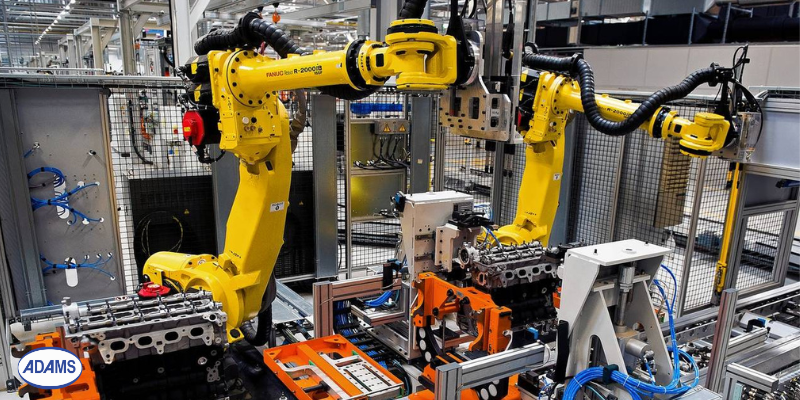
After the AI Wave, Robotics Takes Center Stage
Over the last few days I’ve been following the reporting from Politico and a handful of other outlets about the federal government looking seriously at a national robotics initiative. Nothing is signed. Nothing is official. But when Reuters, Semafor, and Inc all start saying the same thing, I pay attention.
I’ve spent enough time inside factories across Alabama and Florida to know that if this shift happens, it is not just a political headline. It is something that could shape the next decade of industrial growth for the Southeast. And honestly, I think it is overdue.
The administration has been meeting with robotics leaders to talk through manufacturing competitiveness, workforce strain, and how AI driven automation fits into the physical world. After the big push on AI, this feels like the natural next step. Software only gets you so far. At some point you have to move real parts, inspect real products, and keep real machines running.
Why Robotics Matters Now
The U.S. still trails countries like China, Germany, and South Korea in the number of industrial robots deployed. When I walk facilities in Alabama and Florida, I see how that gap shows up. Labor shortages. Quality drift. Slow changeovers. Equipment that works harder than it should.
Robotics is not just for automotive anymore. I have seen it support:
- Aerospace in both Alabama and Florida
- Defense manufacturing
- Electronics and sensor assembly
- Food and beverage production
- Distribution and logistics
- Metalworking and machining
When you combine robotics with machine vision, automated inspection, and reliability monitoring, you get a completely different outcome. Fewer bottlenecks. Less downtime. Higher consistency. And a level of stability you cannot get from staffing alone.
What This Means for Alabama Manufacturers
Alabama has one of the strongest manufacturing bases in the region. Automotive, steel, heavy equipment, advanced materials. Many of these facilities are already dabbling in automation, but a national push could accelerate everything.
I see a few big opportunities:
-
Faster adoption of welding, material handling, and inspection robotics
-
More incentives for automation upgrades
-
Stronger and more reliable supply chains
-
Higher uptime for high volume operations
From Birmingham to Mobile, to Huntsville, there is already momentum. Robotics would pour fuel on it.
What This Means for Florida Manufacturers
Florida is a different story but just as interesting. You have aerospace, defense, ports, medical devices, and logistics all layered together. These industries are primed for robotics.
We are already seeing:
-
Automated inspection for aerospace
-
Precision assembly for electronics and medical devices
-
Autonomous material movement for logistics
-
Reliability tools that help plants avoid downtime
With the size of Florida’s defense sector and port operations, robotics could reshape entire workflows in maintenance, shipbuilding, and high precision manufacturing.
Preparing for What Comes Next
Whether the federal government finalizes anything this year or not, the trend is already moving. Robotics is shifting from a “nice to have” experiment to a strategic necessity.
If I were running a plant, these are the questions I’d be asking right now:
Q: Where can robots take pressure off our workforce?
A: Robots excel at repetitive, physically demanding tasks like machine tending, material handling, welding, and palletizing. Automating these roles allows you to redeploy skilled workers to higher-value tasks like quality control, programming, and process improvement while addressing labor shortages.
Q: Where is downtime hurting us the most?
A: Downtime typically hits hardest on critical bottleneck equipment and during unplanned maintenance events. High-volume production lines, CNC machines, and packaging equipment are common pain points where even minor stoppages cascade into significant production losses and missed delivery commitments.
Q: Which processes need more consistency or accuracy?
A: Processes requiring tight tolerances and repeatability benefit most from automation—including precision assembly, quality inspection, material dispensing, and parts placement. Tasks where human fatigue or variation leads to defects, rework, or scrap are prime candidates for robotic consistency.
Q: What inspection tasks could vision systems take over?
A: Vision systems excel at defect detection, dimensional measurement, part verification, barcode/label reading, and assembly confirmation. They can inspect 100% of parts at production speed with consistent accuracy that human inspectors cannot sustain, especially for small defects or high-volume operations.
Q: How will this help us scale without adding headcount?
A: Automation enables 24/7 operation, increases throughput per shift, and eliminates bottlenecks without proportional labor increases. You can take on more orders, expand production capacity, and grow revenue while maintaining or even reducing your workforce size, improving your cost structure and competitiveness.
At Adams, this is exactly the work we do every day across Alabama and Florida. We help companies understand where automation fits, how to deploy it, and how to build reliability into the heart of their operation.
Whether incentives arrive next year or five years from now, the companies that start modernizing today will be the ones that thrive.
And if you have questions about anything you read in this article or want to discuss how you might be able to take the next step - reach out to us today to discuss.
- Nate
Original article sourced from Politico