


A copper plate. A drop of UV resin. Ten seconds under a UV lamp.
Look at that plate before and after and you cannot tell which is which. Neither can a color camera, a standard vision system, or an operator at the end of a line who has been doing the job for fifteen years. Cured epoxy and uncured epoxy look the same.
A near infrared hyperspectral camera tells them apart in about a second.
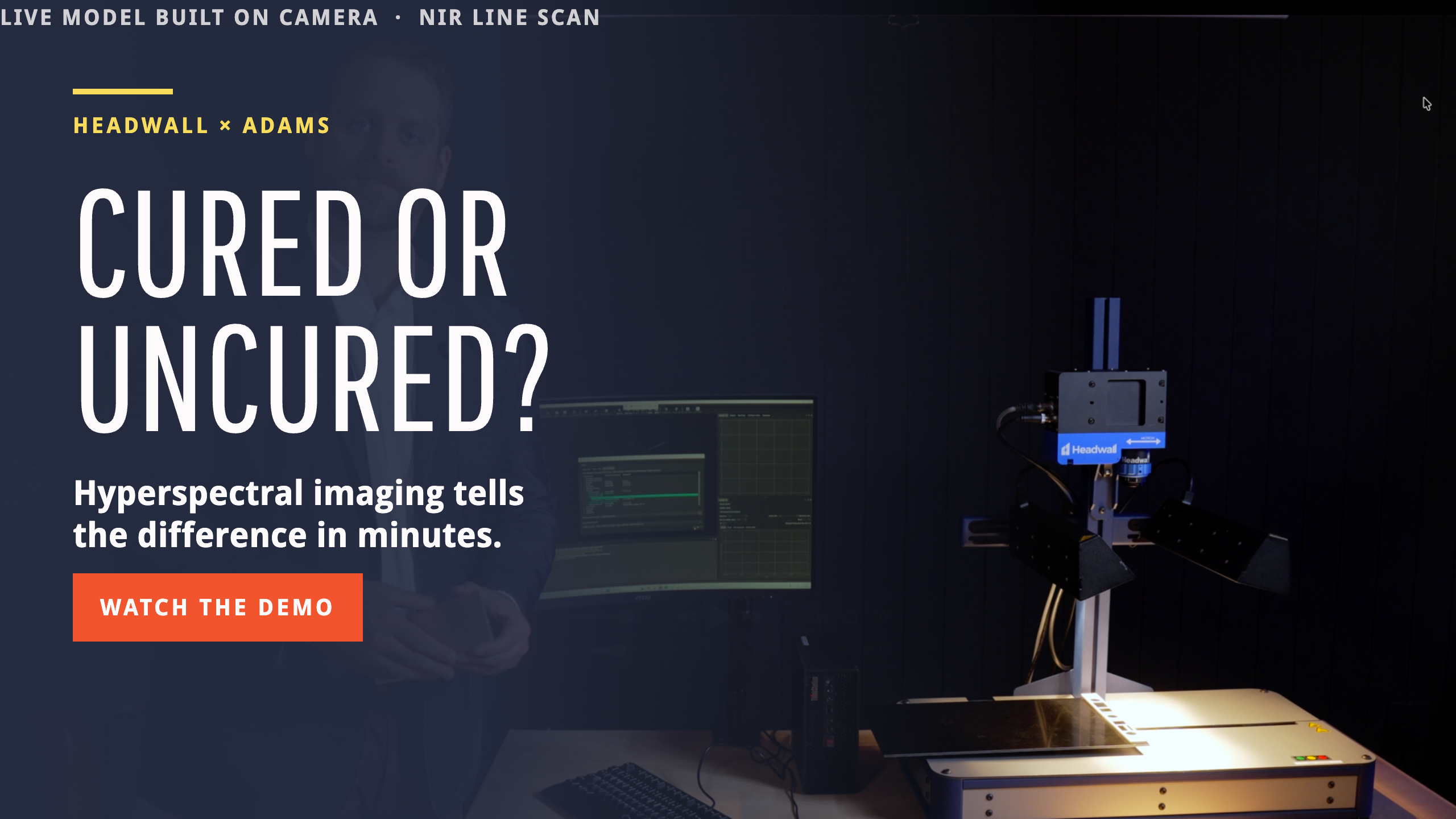
That is the demo George Kelly from Headwall Photonics ran when he brought a camera down to us. It runs about seven minutes and it is worth watching end to end, because what looks like a parlor trick with resin is really the answer to a much larger question: how do you inspect something you cannot see?
Every pixel carries a chemical signature
A normal camera gives you three numbers per pixel. Red, green, blue. That is enough to find a missing part, read a label, or check that a cap went on straight.
A hyperspectral camera gives you hundreds of numbers per pixel, one for each narrow band of wavelength it measures. Stack those together and a pixel stops being a color. It becomes a spectrum. And a spectrum is a fingerprint of what a material is made of, because molecular bonds absorb light at specific wavelengths.
That is why the epoxy demo works. Curing is a chemical event. Cross-linking changes the bonds in the resin, and those bonds absorb near infrared light differently after the reaction than before it. Visually, nothing happened. Chemically, everything did. The camera is reading chemistry, not appearance.
The hardware on the table
The sensor in the video is Headwall's MV.C NIR, and three specs carry more weight than they sound like they should.
900 to 1700 nanometers. Well past visible light, in the range where polymers, moisture, oils, and organics show their strongest and most separable features. Cure state lives out there. It does not live in the visible band, which is exactly why your existing cameras cannot see it.
640 spatial pixels. That is cross-web resolution. It sets the smallest defect you can resolve across the width of a part, and it is the number to do math on before anyone promises you an inspection spec.
Line scanning. The camera images one line at a time while the object moves beneath it, assembling a hyperspectral data cube slice by slice.
That last one gets skipped over, and it should not. Line scanning is not a laboratory compromise you have to undo later. It is how a conveyor already behaves. In the video the motion comes from a perClass scanning stage. On your floor, the motion is the belt you already own. The measurement geometry that works on a benchtop is the same geometry that works over a line.
The boring part is what makes it repeatable
Before any classification happens, George spends a few minutes on setup that looks like nothing is happening.
Auto exposure, tuned for the camera height and the lighting actually on hand. A white reference. A dark reference. Focus. Then a procedure to find the right stage speed so pixels come out square instead of stretched.
That sequence is the entire difference between a demo and an instrument. White and dark references convert raw sensor counts into calibrated reflectance, which is what makes a reading taken today mean the same thing as a reading taken next month, under a different bulb, at a different exposure. Skip it and you own a camera that produces numbers. Do it and you own a camera that produces the same numbers.
If a hyperspectral quote never mentions referencing and illumination, it is a quote for hardware. It is not a quote for an answer.
You train it by painting pixels, not writing code
Then the software, which is perClass Mira.
The workflow is point, click, and drag. George scans the plate with uncured resin on it and paints regions of the image to build classes. Background here, which is the copper plate and the black stage he wants ignored. Uncured epoxy there. He cures the resin under UV, takes a second scan, and paints the cured epoxy from that one.
He also builds a class for glare, which is the most honest thirty seconds in the video. The stage illumination was not optimal for that setup, so instead of pretending otherwise he taught the model what glare looks like, so it would stop mistaking shine for chemistry. Illumination gets engineered around the application. It is a design input, not an afterthought.
Then he runs model search, and the software builds a per-pixel classifier out of the pixel library he just painted. Uncured comes back green. Cured comes back red. The first pass has mistakes, so he adds more pixels to each class, sets the classes as foreground objects so the software looks for conglomerations instead of scattered hits, and runs it again. He can also watch the spectra panel to confirm the two states really do separate, and that he is feeding each class a diverse set of pixels rather than one bright patch.
Working model, start to finish, in a few minutes.
Notice who built it. Not a data scientist. The person who already knows what a good part looks like. That is the real unlock here, and it is bigger than the epoxy: the domain expert builds the model, and nobody writes a line of code.
Where this shows up on a plant floor
Epoxy on a copper plate is a stand-in. The pattern generalizes to any problem where two things look identical and are not.
- Adhesive and sealant beads: present, continuous, the right material, and actually cured
- Coating coverage, thickness, and uniformity
- Moisture content in powders, grain, pharmaceuticals, and board stock
- Foreign material and contamination in food processing
- Plastic and resin identification for sorting and incoming material verification
- Composite and bond line quality before a part moves to the next station
Every one of those is a place where the answer today is a sample, a destructive test, or a warranty claim six months from now. Hyperspectral changes the unit of inspection from a sample to every part, at line rate, without touching the product.
Lab first, then the line
The sequencing George closes on is the right one. Start on a benchtop with a scanning stage. Prove your two conditions actually separate spectrally. Then take the same model inline.
That order matters more than it sounds like it does. Feasibility is cheap in a lab and expensive on a production line. If your cured and uncured parts do not separate in the near infrared, you want to learn that on a copper plate, not after the enclosure is built and the conveyor is cut.
There is more in the software than a seven minute video can hold. Narrowing regions of interest to specific spectral bands. Regression modeling, for when you need a number like percent moisture instead of a pass or fail class. Deployment to an inline system.
If you have a defect you are catching downstream, catching by sample, or not catching at all, the question worth asking is whether it has a spectral signature. That is a short conversation and a benchtop scan. Bring us the part.
