


- UV light inspection relies on human operators to spot glowing tracers, making it subjective and prone to fatigue-driven errors.
- Standard Automated Optical Inspection (AOI) struggles to verify if a coating is fully cured or just present on the surface.
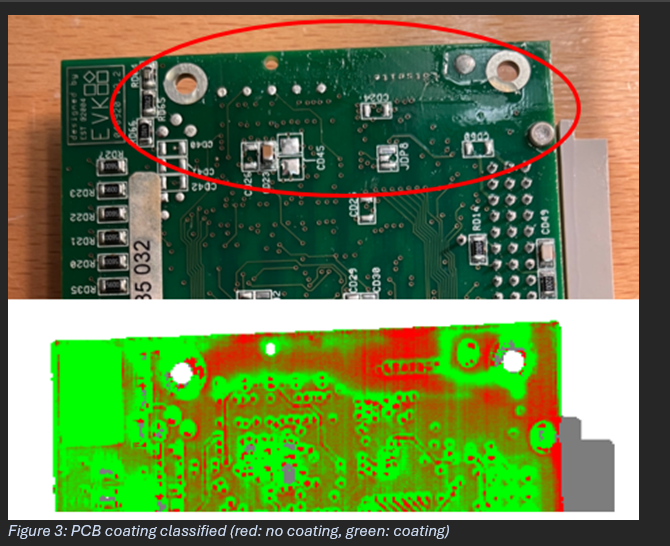
- Headwall hyperspectral imaging captures the chemical signature of the coating, detecting voids, thickness variations, and curing state instantly.
Most conformal coating defects reach the field because the inspection method relies on a human staring at a glowing board under a blacklight. When you are building avionics or defense electronics, "it looks green to me" is not a reliable quality control standard.
Why Manual UV Inspection Fails
Manual UV inspection fails because it is subjective, exhausting, and incapable of measuring the actual chemical state of the coating. Operators are looking for the presence of a UV tracer added to the coating material. After staring at hundreds of boards, eye fatigue sets in, and small voids or thin spots are easily missed.
More importantly, UV light only tells you if the tracer is there. It does not tell you if the coating is the correct thickness, and it certainly cannot tell you if the polymer has fully cross-linked and cured. A board can glow perfectly under UV light and still fail in a humid environment because the coating was applied too thin or didn't cure properly.
What Most Plants Get Wrong About AOI
Most companies believe that upgrading from manual UV inspection to standard Automated Optical Inspection (AOI) solves the problem. In reality, traditional RGB cameras in AOI systems are just automating the same flawed visual check. They look for the color of the UV tracer. If the camera sees the right color, the board passes.
But standard AOI is easily fooled by ambient light changes, reflections from solder joints, and variations in the PCB substrate. Like the human eye, it cannot verify the chemical composition or the curing state of the conformal coating. It is a surface-level check for a problem that requires chemical-level verification.
What Actually Works: Hyperspectral Imaging
To guarantee conformal coating coverage and curing, you have to look beyond the visible spectrum. Headwall hyperspectral imaging captures the full spectral signature of the materials on the board.
Instead of looking for a glowing dye, a hyperspectral camera detects the actual chemical composition of the polymer. It can instantly differentiate between bare FR4, solder mask, components, and the conformal coating itself.
Because it measures chemical signatures, it can detect microscopic voids, verify uniform thickness, and even confirm whether the coating has fully cured. This takes the subjectivity out of the process and provides a definitive, data-driven pass/fail result.
Frequently Asked Questions
Why is UV light used for conformal coating inspection?
UV light is used because most conformal coatings contain a fluorescent tracer that glows under blacklight. This makes it easier for human operators or basic cameras to see where the clear coating has been applied on the board.
Can standard AOI detect conformal coating defects?
Standard AOI can detect gross missing areas of coating by looking for the UV tracer, but it struggles with thin spots, bubbles, and verifying if the coating is fully cured. It relies on color rather than chemical composition.
How does hyperspectral imaging improve PCB inspection?
Hyperspectral imaging improves PCB inspection by capturing the chemical signature of the board's surface. This allows it to detect the actual conformal coating polymer, ensuring complete coverage, proper thickness, and full curing without relying on UV tracers.
What industries require automated conformal coating inspection?
Aerospace, defense, automotive, and medical device manufacturing require automated conformal coating inspection. These industries produce high-reliability electronics that must survive extreme environments, making manual inspection too risky.
If your quality team is still relying on blacklights and operator judgment to pass high-reliability boards, we can help you automate the process with actual chemical verification.
-Nate

Let us know if you need help with conformal coating inspection.