


TL;DR
- Traditional RGB machine vision cameras only see surface appearance, making them blind to chemical differences between materials.
- Vision systems fail when tasked with sorting or verifying materials that look the same but have different compositions.
- Headwall hyperspectral imaging captures hundreds of wavelength bands to create a unique chemical fingerprint for every pixel.
- Upgrading to hyperspectral technology shifts inspection from measuring dimensions to verifying actual material chemistry.
What Are the Limitations of Traditional RGB Machine Vision?
Traditional RGB machine vision systems are incredibly effective at measuring dimensions, verifying part presence, and reading barcodes. However, their fundamental limitation is that they only capture light in three broad wavelength bands: red, green, and blue. This means they "see" the world much like the human eye does, relying entirely on surface contrast, color, and shape to make inspection decisions.
When a manufacturing defect or material variation does not produce a visible contrast in the RGB spectrum, a traditional vision system will miss it entirely. If a clear adhesive is missing from a clear plastic substrate, or if two visually identical powders are mixed incorrectly, an RGB camera cannot detect the error.
This reliance on surface appearance makes standard machine vision inadequate for complex material detection tasks, regardless of how sophisticated the lighting setup or software algorithm may be.
Why Do Vision Systems Fail When Materials Look Identical?
Vision systems fail when materials look identical because they lack the ability to analyze chemical composition. In many modern manufacturing processes, the critical differences between acceptable and defective products are molecular, not visual. A classic example is recycling sortation, where a PET plastic bottle and a PVC plastic bottle look exactly the same to a standard camera, yet mixing them ruins the recycling batch and can damage downstream processing equipment.
Similarly, in food processing, a piece of clear plastic packaging that falls into a batch of clear liquids or light-colored foods will be invisible to an RGB system. The camera simply cannot generate enough contrast to distinguish the foreign object from the product. When manufacturers try to solve this by endlessly tweaking lighting or software tolerances, they often end up increasing false reject rates without actually solving the underlying material detection problem. This is precisely the scenario described in our earlier post on why machine vision systems give false readings.
How Does Hyperspectral Imaging Differ from Standard Machine Vision?
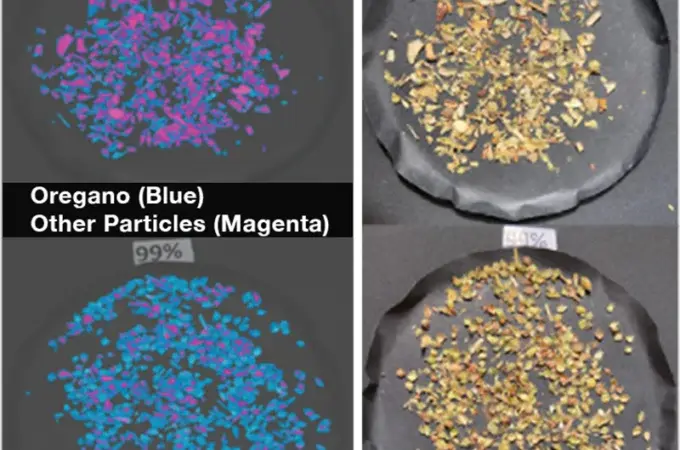
Headwall hyperspectral imaging differs from standard machine vision by capturing data across dozens or hundreds of narrow wavelength bands, extending far beyond the visible spectrum into the Near-Infrared (NIR) and Shortwave Infrared (SWIR) ranges. Instead of assigning a simple color value to each pixel, a hyperspectral camera records a complete spectral signature — a chemical fingerprint — for every point in the image.
Because different materials absorb and reflect light differently based on their molecular structure, hyperspectral imaging can instantly differentiate between materials that look identical to the naked eye. It does not rely on visible contrast; it relies on chemical reality. This allows the system to identify material composition, detect moisture content, and find hidden contaminants with laboratory-grade precision at full production speeds.
| Capability | RGB Machine Vision | Headwall Hyperspectral Imaging |
|---|---|---|
| Detect surface defects | Yes | Yes |
| Measure dimensions | Yes | Yes |
| Identify material composition | No | Yes |
| Detect moisture content | No | Yes |
| Find clear-on-clear contamination | No | Yes |
| Verify chemical cure state | No | Yes |
| Differentiate identical-looking materials | No | Yes |
What Are the Practical Applications of Hyperspectral Material Detection?
The practical applications of hyperspectral material detection span across multiple industries where chemical verification is critical. In the food and beverage sector, it is used to detect foreign objects like plastic, wood, or rubber that standard X-ray or vision systems miss. It can also measure the moisture content or fat distribution within a product to ensure consistent quality and accurate labeling.
In pharmaceutical manufacturing, hyperspectral imaging verifies that the correct active ingredients are present in the correct concentrations within a tablet, ensuring patient safety and regulatory compliance. In the recycling industry, it is the gold standard for rapidly sorting mixed plastics, textiles, and construction materials by their true chemical composition, enabling higher purity recovery rates and supporting circular economy initiatives. For manufacturers using Headwall systems, the same platform that verifies epoxy cure and measures coating thickness can also perform material identification — making it one of the most versatile inspection investments available.
Frequently Asked Questions
Why can't a standard camera detect different types of clear plastic?
A standard camera cannot detect different types of clear plastic because it only captures visible light (RGB). Clear plastics like PET, PVC, and polycarbonate all transmit visible light similarly, meaning they lack the visual contrast required for a standard camera to tell them apart. Hyperspectral imaging reveals their distinct molecular signatures.
What is a spectral signature?
A spectral signature is the unique pattern of light absorption and reflectance across various wavelengths for a specific material. It acts as a chemical fingerprint, allowing Headwall hyperspectral systems to identify materials based on their molecular makeup rather than their surface appearance.
Does hyperspectral imaging require special lighting?
Yes, hyperspectral imaging requires broadband illumination that covers the specific spectral range being analyzed, such as halogen or specialized LED lights that emit across the Near-Infrared (NIR) or Shortwave Infrared (SWIR) spectrum. Headwall systems are designed with compatible illumination as part of the integrated solution.
Can hyperspectral imaging detect moisture?
Yes, hyperspectral imaging is highly effective at detecting moisture. Water has strong, distinct absorption bands in the Near-Infrared (NIR) spectrum near 1,450 nm and 1,940 nm, allowing the system to accurately map and quantify moisture content across a product's surface.
Is hyperspectral imaging slower than standard machine vision?
While hyperspectral imaging processes significantly more data than standard vision, modern line-scan (pushbroom) hyperspectral cameras and advanced processing software are designed to operate at high production speeds, making them suitable for real-time inline inspection without slowing the line.
If your current vision systems are struggling with false readings or failing to detect critical material variations, you may be hitting the limits of RGB technology. Contact Adams Corp today to explore how Headwall hyperspectral imaging can bring chemical-level clarity to your inspection process.
- Nate
