


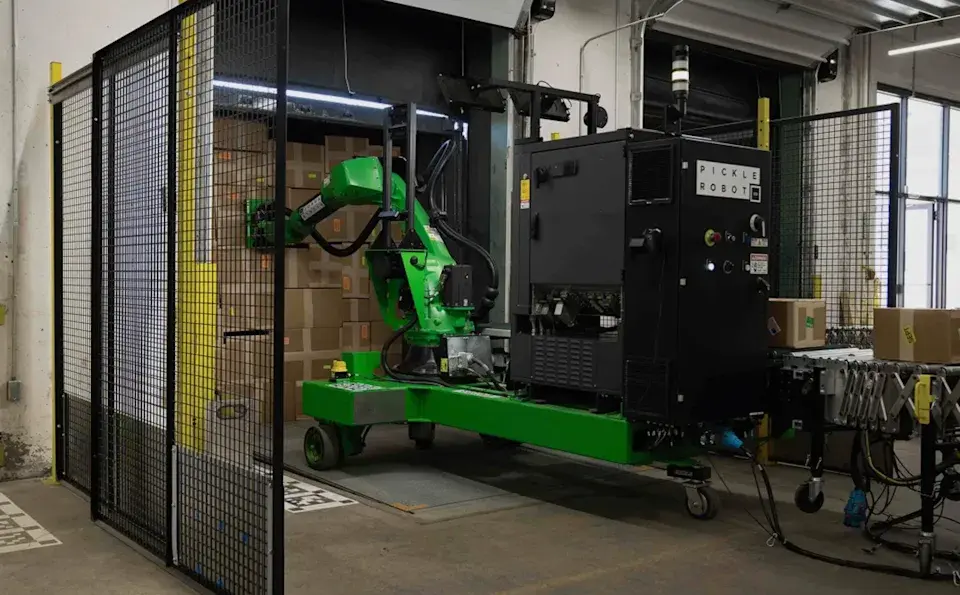
- UPS committed $120 million to 400 Pickle Robots to automate inbound trailer unloading — part of a $9 billion, four-year automation program targeting $3 billion in cost savings by 2028.
- Manual inbound unloading is the most volatile workflow in logistics and manufacturing distribution — and the one most companies have left untouched.
- The Pickle Robot delivers a proven payback of roughly 18 months and deploys in existing facilities without major infrastructure changes.
- Industrial robot payback periods have dropped from 5.3 years in 2019 to 1.3 years in 2024. Manual labor is no longer the safe, flexible option — it is the expensive, unpredictable one.
- For plants in Florida, Alabama, and the Caribbean, the same logic applies to palletizing, case packing, and material handling: automate the step that causes the most downstream variability.
If your downstream sortation or picking lines are constantly starved or flooded, the problem usually isn't the line itself — it's the manual unloading at the dock.
UPS recently committed $120 million to purchase roughly 400 robotic systems from Pickle Robot, designed specifically to unload trailers and shipping containers autonomously [1]. This was not a press-release pilot or an innovation center showcase. It was a scaled purchase that followed multiple years of validation in live facilities. And it targets one of the least automated, most physically demanding workflows in logistics: inbound unloading at the dock.
Why Manual Inbound Unloading Fails at Scale
While sortation, storage, and picking have seen steady automation investment over the past two decades, truck unloading has remained overwhelmingly manual across the industry. The reasons are well understood by anyone who has spent time on a dock.
Loads are unstructured. Cartons vary widely in size, weight, and stability. Containers shift during transit. Most facilities were never designed for robotic access at the dock door. And the work itself — sustained repetitive lifting across a full shift — is exactly the kind of task that drives turnover and injury claims.
Manual Unloading Fails When:
- Loads are unstructured and carton dimensions vary across a single trailer
- Labor turnover leaves the dock understaffed during peak periods, immediately starving downstream systems
- Physical strain drives injury rates and absenteeism, compounding the staffing problem
- Throughput variability at inbound cascades into storage availability, picking wave timing, and outbound cutoffs
Inbound also sits at the very beginning of the operational chain. When the dock slows down, the entire facility feels it. You can have the most sophisticated automated storage and retrieval system in the building, but if you cannot get product off the truck consistently, that capital investment is sitting idle waiting for a manual bottleneck to clear.
What UPS's $9 Billion Strategy Actually Tells You
UPS's "Network of the Future" program is a four-year, $9 billion automation investment across more than 60 U.S. facilities, with a stated goal of $3 billion in cost savings by 2028 [2]. By late 2025, UPS had already automated 63 percent of its hub volume and plans to triple the number of automated buildings to 400 nationwide [3]. Most of those projects are retrofits of existing facilities — not greenfield builds.
The $120 million Pickle Robot purchase fits that pattern. The system is a robotic arm on a mobile base that drives directly into standard trailers and containers, picks cartons using suction, and places them onto conveyors. It handles packages from small six-inch cubes up to 32-inch-wide boxes, manages loose-packed freight up to 50 pounds, and unloads a typical trailer in roughly two hours — processing 400 to 1,500 cases per hour depending on the freight type [1] [3].
The demonstrated payback period is approximately 18 months [1]. That number explains the scale of the order. Large operators do not deploy hundreds of units unless the economics are already proven and repeatable.
What Most People Get Wrong About Automation ROI
Most companies evaluate automation on a simple headcount-replacement basis. That math misses the actual value.
The real ROI of automating a manual bottleneck is throughput stability. When a robot handles inbound unloading, the rest of the facility receives a consistent, predictable flow of product. Picking waves run on schedule. Storage systems stay balanced. Outbound cutoffs are met. The downstream cost of variability — idle automated systems, missed shipments, overtime to compensate — is often larger than the direct labor cost being replaced.
The broader market data supports this. Industrial robot payback periods have dropped from approximately 5.3 years in 2019 to around 1.3 years in 2024, according to McKinsey's Automation Benchmark [4]. Collaborative robots average a payback of about 195 days, according to Universal Robots' own customer data [4]. Food and consumer goods was the fastest-growing segment for North American robot orders in both 2024 and 2025, with orders jumping 105 percent year-over-year in Q3 2025 alone — driven primarily by labor availability concerns [5].
Manual labor is no longer the safe, flexible fallback. It is the expensive, unpredictable option.
| Metric | 2019 | 2024 |
|---|---|---|
| Average industrial robot payback | ~5.3 years | ~1.3 years |
| Average cobot payback | ~3 years | ~195 days |
| Global robot installations (annual) | ~380,000 units | 500,000+ units |
| US robot density | ~200/10,000 workers | 295/10,000 workers |
Sources: McKinsey Automation Benchmark, IFR, Universal Robots Customer Insights Report [4]
What Actually Works: Automate the Source of Variability
The Pickle Robot succeeded at UPS because it was built for brownfield deployment. It does not require a newly designed facility or extensive infrastructure upgrades. It works in the buildings that already exist.
For manufacturing and distribution plants in Florida, Alabama, Puerto Rico, and the Dominican Republic, the same principle applies. The question is not whether to automate — it is where to start.
The right answer is usually the step that causes the most downstream variability. In most plants, that is one of three places:
End-of-line palletizing. Manual palletizing is physically demanding, prone to inconsistency, and one of the hardest positions to staff and retain. A robotic palletizer with a mean time between failures of 80,000 to 100,000 hours does not fatigue, does not call in sick, and does not stack a pallet differently at the end of an eight-hour shift [5]. FANUC's palletizing systems, which we deploy across food and beverage, packaging, and distribution facilities in our territory, can handle multiple SKUs with software-managed pattern changes that take seconds rather than a technician visit.
Inbound material handling. If your receiving dock is a manual operation feeding automated downstream systems, you have built a variability source into the front of your process. Collaborative robots and mobile manipulators can be deployed in existing dock configurations without major facility modifications.
Case packing and pick-and-place. For facilities running multiple SKUs with frequent changeovers, manual case packing creates quality variability and changeover delays. Modern cobots from Universal Robots and FANUC handle these applications with quick-change tooling and recipe-based changeovers that operators can manage from the HMI.
When to Call for Backup
If your operation is consuming significant labor resources at inbound, palletizing, or end-of-line — and you are still dealing with inconsistent throughput, injury claims, or turnover-driven quality problems — the economics of automation have almost certainly already shifted in your favor.
We can help you run the numbers. Whether it is a FANUC palletizing cell, a Universal Robots cobot for case packing, or a broader automation assessment of your facility, Adams Corp has been doing this work in Florida and Alabama since 1960. We know what works in brownfield plants and what looks good in a brochure but falls apart on the line.
If you are seeing this in your plant, we are happy to take a look.
-Nate

Frequently Asked Questions
Why is manual truck unloading so difficult to automate?
Truck unloading involves unstructured loads, variable carton sizes, and confined spaces that shift during transit. Most facilities were not designed for robotic dock access, and the physical variability of the work has historically made automation impractical. Systems like Pickle Robot solve this by using a mobile robotic arm that drives into existing trailers without requiring facility modifications.
What is the ROI on warehouse and distribution automation?
Industrial robot payback periods have dropped from approximately 5.3 years in 2019 to around 1.3 years in 2024. Collaborative robots average a payback of about 195 days. The Pickle Robot system deployed by UPS has a demonstrated payback of roughly 18 months. The ROI comes not just from labor cost reduction but from throughput stability and reduced downstream variability.
What types of automation make sense for food and beverage or distribution plants?
End-of-line palletizing, inbound material handling, and case packing are the most common starting points. These are physically demanding, high-turnover roles where robotic systems deliver consistent quality and predictable throughput. FANUC and Universal Robots cobots are well-suited to these applications in existing brownfield facilities.
What does UPS's $9 billion automation investment mean for manufacturers?
It signals that the economics of automation have fundamentally shifted. When a company the size of UPS commits $9 billion to retrofit existing facilities with robotics — and targets $3 billion in savings — the underlying math is no longer speculative. The same ROI logic applies to manufacturing and distribution plants of any size.
References
- Why UPS Just Bought Hundreds of Truck-Unloading Robots — Warehouse Automation
- UPS Releases 4Q 2025 Earnings and Provides 2026 Guidance — UPS Investor Relations
- UPS Leans Into $9 Billion Automation Strategy with Robotics Rollout — Sourcing Journal / WWD
- Robotics Statistics for Manufacturers — DEVELOP LLC
- Case Packing and Palletizing Automation in 2026 — Food Industry Executive